Scary Spider Season currently includes the invasive Joro
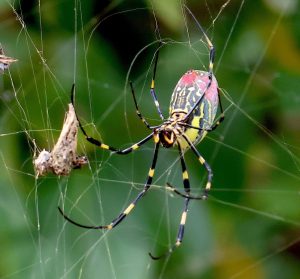
Joro in Laurens, SC – Photo by Judith Brown
Laurens County, South Carolina – During the classic spooky season plastic spiders greet trick-or- treaters in front yards and porches, but it’s also almost egg-laying season for the Joro spider, a large brightly-colored and unwelcome spider growing in numbers in the Upstate South Carolina region.
While we’re supposed to let outdoor spiders do their job and keep down the population of flies, researchers at Clemson and the University of Georgia explain the Joro spiders are not among those that need protection.
“It’s a striking spider and it is not dangerous to humans, but it is a very invasive spider and despite everything we can do, it seems to be coming,” said Clemson Extension Agent Bryan Smith, adding that they have already been documented in Laurens County. “We recommend when you see them to kill them.”
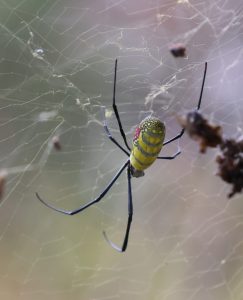
Joro Spider in Laurens, SC – Photo by Judith Brown
They first appeared in north Georgia about a dozen years ago after arriving likely via a shipping container, and are becoming more prevalent in the northwest section of South Carolina. A native of East Asia, they are making them- selves very much at home in the region and according to clemson.edu, have recently been spotted as far north as Boston, Massachusetts.
Like native spiders, they use their very sticky yellow-colored webs to trap insects, but researchers have found that where Joro spiders are high in numbers, other native spiders are rare, if present at all.
The female spider is extremely large with dark blue and yellow stripes on the back, a bright yellow belly with red or pinkish-red markings and very long and shiny black and yellow legs stretching about four inches end to end.
The Joro spider egg webs are estimated to hold up to 800 to 1,000 eggs, and this is the season when the females and small brown males are most active. They can be seen in large yellow tinted webs on the outside of homes and buildings, in landscape shrubs and in wooded areas and unlike the shy native spiders who tend to build webs primarily at night, Joros are also active in the day.
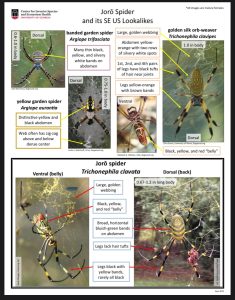
Chart by University of Georgia and the Center for Invasive Species and Ecosystem Health
For those venturing out in search of the Joros, Smith cautioned them not to kill the native spiders which are so beneficial in the region, such as the black and white striped writing spiders with their zigzag web “writing,” and other orb weavers with markings similar to the Joro, such as the yellow garden spider, the banded garden spider or the golden silk orb weaver.
There are many charts comparing details of the Joro with similar native spiders which should be protected, including the Center for Invasive Species and Ecosystem Health.
Smith said the Joro’s very sticky web can be removed and the spider stepped on, or a recent Clemson study suggested several simple garden insecticidal sprays which can be directed at the spider.
This originally ran Page 1 of the Wednesday, Oct. 29, 2025 issue of The Laurens County Advertiser.